
In this post, I share the practical steps on how to save money on groceries. These ideas will help you save money while feeding your family well. You will feel confident that you are not going to overspend on food.
Food is one of our highest expenses as a family of four in Singapore, a country well known for its high cost of living. We usually spent an average of $800 – $1000 on groceries, not including dining out.
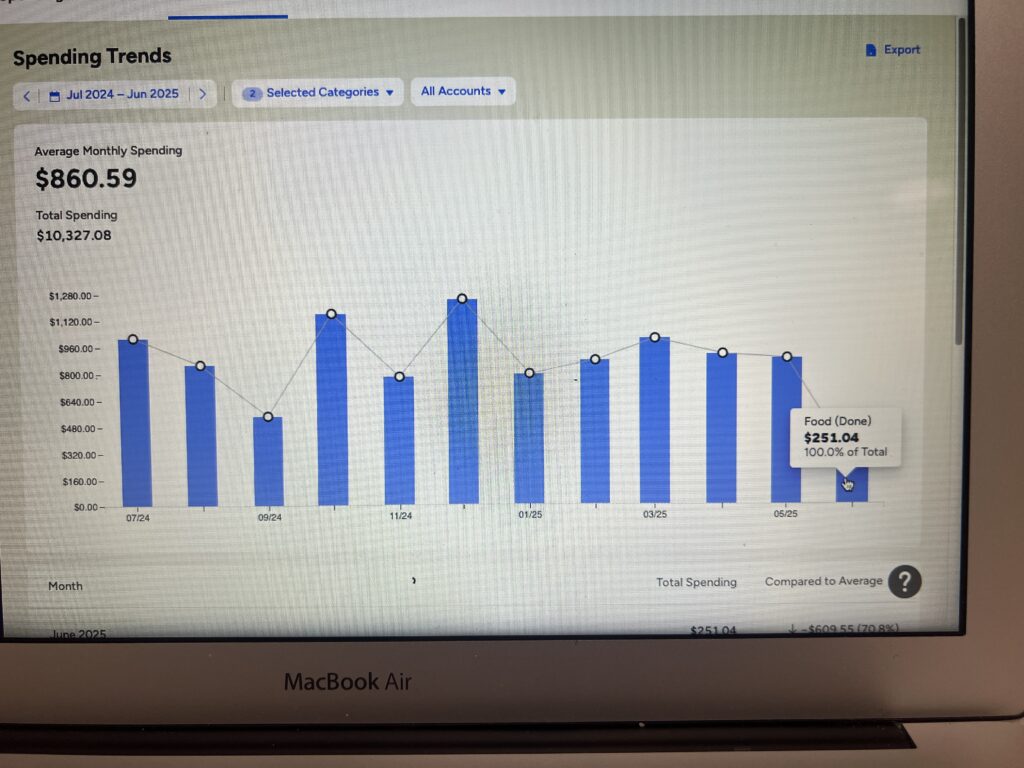
My shopping habits was influenced by how tired I was, whether the kids were with me, or how busy I felt that week. It became an expense that could quietly spiral out of control so I wanted a reliable system to spend a predictable amount of money each month on groceries.
I set out on a challenge to spend $250 / month on groceries for our family of four. You can read about my full experience here or check out how I finally designed my flexible meal plan system.
For this post, let’s dive right into easy habits to start saving money.
13 Habits to Save Money on Groceries
1. Set a realistic monthly budget.
Households in Singapore typically spend around $456 on groceries a month and $894 on dining out. This is a good benchmark to begin with if you have an average family of 4.
2. Track your expenses.
If you are serious about saving money on groceries, log every single purchase. This information shows your spending habits. Are you spending too much at a particular store or in a particular month? You can spot patterns you don’t notice day to day and identify opportunities to stretch your dollar.
3. Shop alone, shop full.
Impulse purchases will spike when you are hungry or when you cannot say no to the kids. Shop when you’re calm, fed and focused.
If you have to bring your children along, give them the grocery list and turn it into a fun grocery hunt for them. If you struggle with saying no, give them a small budget for autonomous decisions. “You have $5 to buy a healthy snack for school next week.”
4. Use a basic meal formula, not a rigid plan.
Buy staple ingredients that are on discount and make simple 30-min meals from your recipe bank to ensure that your family gets a healthy portion of protein, carbs and fibre.
Do this instead of following a rigid meal plan where you have to buy ingredients even at full price.
5. Buy ingredients on discount.
Planning your meals around what is on sale can save you 10 – 20% of your grocery budget.
6. Frozen meats often cost less.
Fresh meats can cost 20 – 50% more than frozen ones. Frozen versions, especially in bulk, taste just as good and cost much less.
I use frozen chicken thigh, whole chicken, minced meat and fish fillets for stir-fries, stews, braises, soups – and honestly, they don’t taste different.
7. Shop at discount supermarkets.
Prices for the exact same item can vary drastically between stores. In Singapore, places like Sheng Shiong often have better prices for pantry staples, frozen items and fresh produce.
Find 1 – 2 places near your home that you can go back to to consistently save money.
8. Buy house brand items
Most housebrands source raw ingredients directly from the same farms and factories as well-known brands. Quality is just as good most of the time. They reduce cost with simpler packaging, lower advertising cost and lower shelf fees. As the supermarket owns the brand, they don’t need to pay extra to keep it on the shelf. The savings are transferred directly to you.
9. Shop online
Shopping online allows you to compare prices and shop when you are calm and focused to avoid impulse buys. Make use of vouchers from promotions to get further discounts and save on delivery fees.
We buy coffee beans for $25/kg (usual price $41/kg) from Amazon and nuts for (<$10/kg) from Shopee.
10. Stick to a small list of local staples and condiments
When you limit your pantry to a handful of versatile ingredients you use regularly, you spend less to maintain and top them up.
While it might be fun to try a trendy recipe that requires Gojuchang, how often will you actually use it?
11. Choose recipes with fewer ingredients
Simple recipes save money, time and energy. Look for meals that use five ingredients or less and rely on what you have on hand. More often than not, it is perfectly fine to swap out one ingredient for another.
I compiled a list of simple recipes my family enjoys and these have saved me a ton of money and time.
12. Shop your freezer first
Make it a habit to use up what you have and check what is left in the fridge or freezer before a shopping trip. Plan your meals around what is already there. If you stick with simple recipes, you are likely to be able to use up what you have quickly.
13. Buy the right quantity – not too much
Buy what you need till your next grocery trip.
Learn your family’s consumption patterns and build your trips around it.
Useful questions to ask yourself are: How many meals will 6 chicken thighs make? How frequently will I need to buy milk, eggs, bread or fruit?
I find it helpful to stock up on frozen meats once or twice a month while buying fresh vegetables and fruits once a week.
3 Mindset Shifts to Save Money on Groceries
Prioritise simplicity over constant variety.
As a mum, I used to feel pressured to serve something new ever so often. Actually, what my family needs are just their favourite healthy, delicious meals. So, I created a recipe bank with meals that I can depend on – no one complains because the kids love all the recipes.
So I don’t have to constantly create interesting meals with new ingredients. I spend less time thinking, cooking and less money on ingredients.
Use systems, not your willpower.
On tired and busy days, willpower and motivation disappears. It’s easy to go on a spending spree and reward yourself with a nice treat, even from the supermarket.
Having a system helps you make frugal decisions ahead of time.
Instead of winging it, use a system to guide your decisions on what to cook and what to buy when you feel rested and calm.
Be clear with your goals
Mine is:
Always buy on discount what I need until our next trip
With this intention in mind, I stock up on what we need that is on sale.
And instead of having a fixed meal plan, I stay flexible by rotating around simple recipes around what I have on hand.
My personal experience
Spending just $450 a month was not always the case for me. In June 2025, I set out on a challenge to spend $250 / month on groceries for our family of four because our food expense was getting out of control as we often spend about $800 – $1000 and even $2000 on months with festive seasons.
You can read about my personal experience on my $250 grocery challenge here.
It takes time to change habits and grocery shopping patterns. You have the best chance of success if you have a system you can depend on.
From my personal experience, I created TWM Grocery and Meal System to manage meals, groceries and shopping.
It is easily to apply for any household. It works no matter where you live and what your family size is. The system can cut your grocery bills, take the mental load off meal planning and free up time and energy.
Check out TWM Grocery and Meal System.